Cousin Bill Llewellyn part 3
This is the third segment in the series of the interview with Cousin Bill Llewellyn from 2004 by Rutgers University. He refers to his trip to see his parents in the winter season in Sebring, Florida, to see his parents. This is where we have lived all our adult lives (Terrie is a native of Sebring). My grandparents, William T. and Ella H. Llewellyn, had a winter home here on Dove Avenue in Sebring Hills they purchased in 1959 and began our family exodus from Philadelphia. We moved here in February 1963. But Charles and Emily Llewellyn stayed here back in the 1930’s and 1940’s.

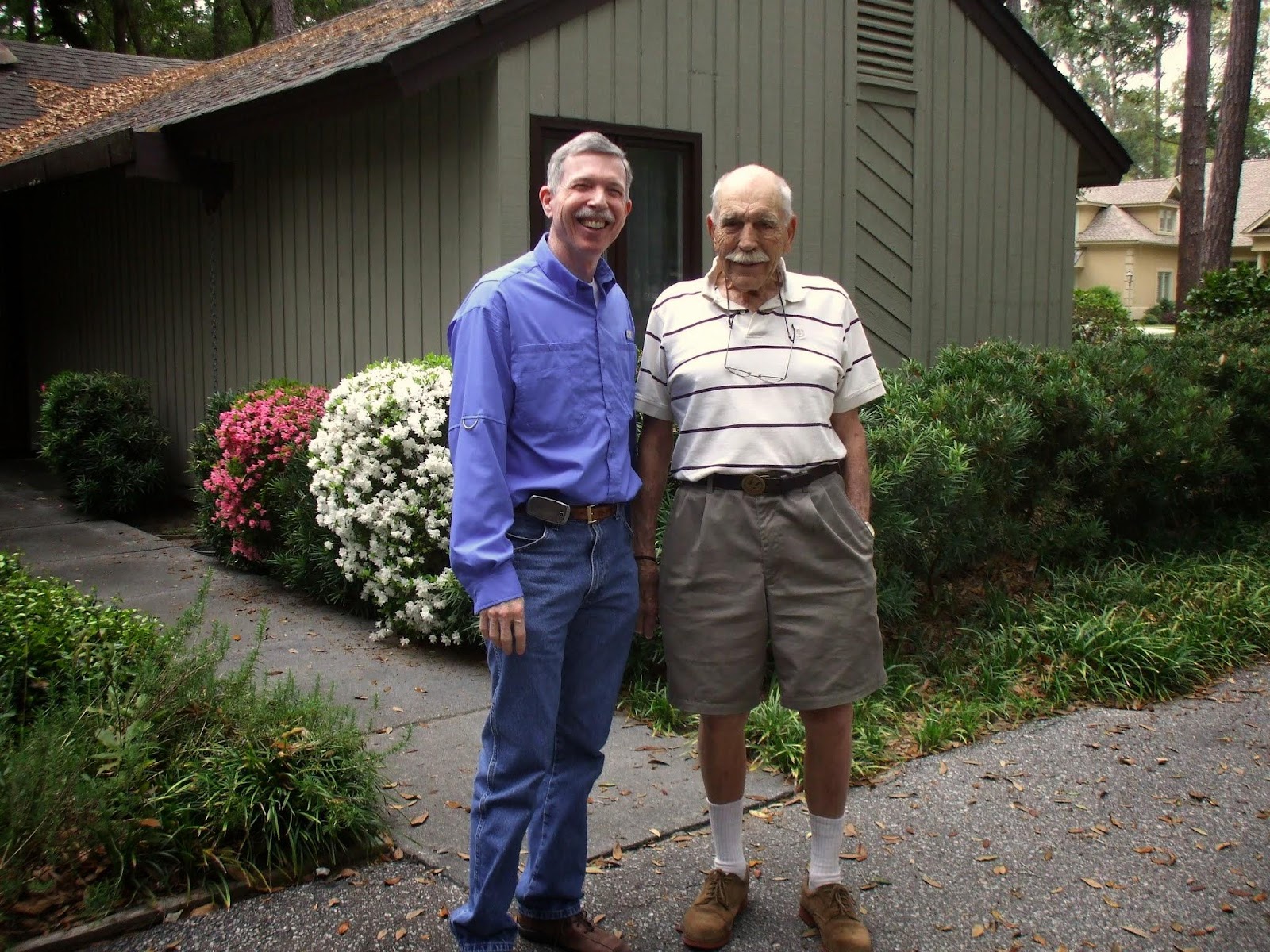
Bill at his home with his beloved Springer Spaniel and cousins Dan and Jessica Llewellyn visiting from Hammond, LA 2005.
SH: This is side two of tape one. Please, continue; you were telling me about the Roadster.
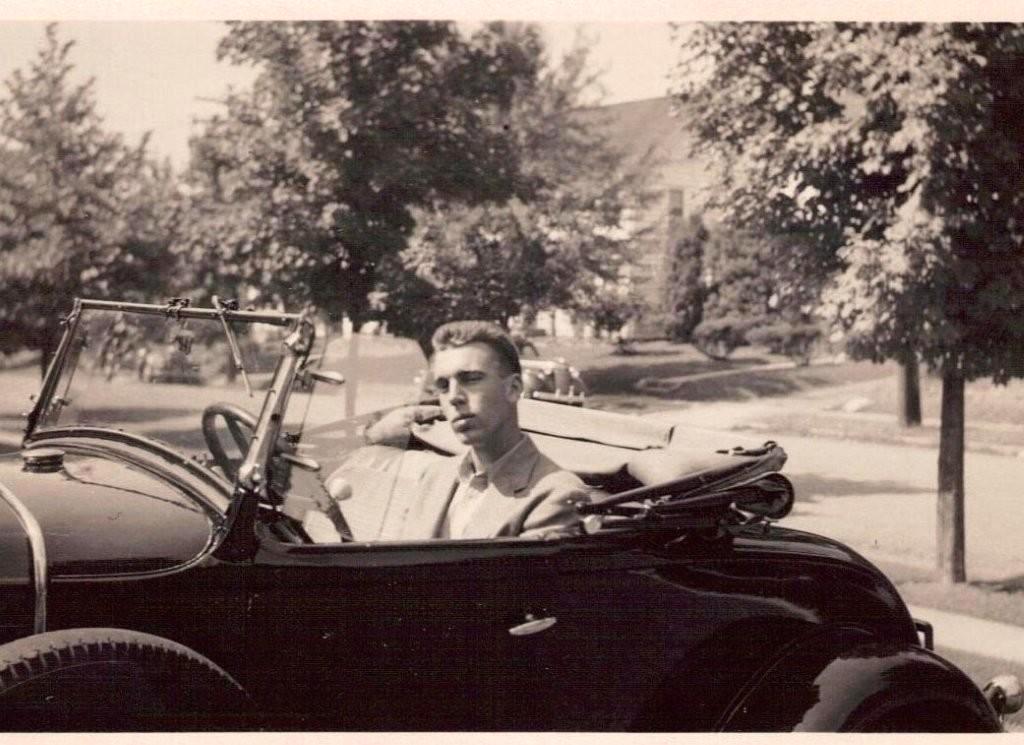
WL: Yes, so, we’d go up to these nightclubs. … [For] the valet parking guy, we’d take the thing [the top?] off, … but there were only a couple of girls that were willing to do that with me. They wanted the other car. [laughter]
SH: What are some of your fondest memories of Rutgers?
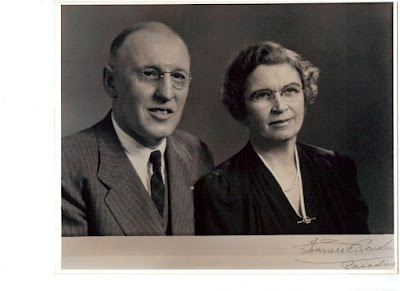
Bill’s parents, Charles B. and Emily Frame Llewellyn
WL: Oh, well, you’re talking about traveling [before]. … I’d work [during] the summer, and then, I’d quit two weeks before I had to get back to college. … I did it with a couple of different friends, but … we’d go up into the [mountains]. One year, we went into the White Mountains and drove out on Cape Cod and, another one, we went up in the Adirondacks, and then, we did backpacking, and so, I saw New England on [these] vacations. My parents had gotten in the habit, while I was at Rutgers, of spending some months in Sebring, Florida, and I hitchhiked down one winter and spent a week with them and drove back with them and saw that. … Mostly, we went, drove, back to Ohio to see relatives. So, I knew the Lincoln Pike and (Tuscarora?) and all the mountain ranges in western Pennsylvania pretty well, [laughter] but, other than that; … oh, and my mother, when I was about a year old, got tuberculosis, and so, … what they had to do then [was], they had to go to sanitariums. … She went up to (White Haven?) Sanitarium in the Poconos, … when I was, say, about a year old, and was there, I think, … nine months, but I’m not really sure, and then, after that, why, my father always had domestic help. … I think his conscience hurt him a little, that my mother worked her tail off with two daughters and me, [laughter] and so, he had a little guilty conscience and we always had either a cousin from Ohio or something [staying with us]. Cousin Ester, I mean, helped raise me, I remember, when I was a little baby. … So, when it came time to move, in 1930, from Philadelphia to Plainfield, my father found a house and decided [to rent it]. Then, he sent my mother and me off to California, … for her to visit her family, who all lived … either in Pasadena or nearby, and I went along. So, that was a great train trip, all the way to California
16
and stopping at the Grand Canyon and Royal Gorge. … Then, my grandparents were living in Pasadena. My Aunt Laura, my mother’s older sister, who never married, lived with them and had a little Chevrolet that she ran around in, and so, we went down to Lake Elsinore and some
other places and my Uncle Joe lived in Pasadena. He worked at an organ factory, I think, in the … ‘20s and ‘30s, and ended up as the … head of maintenance for Mount Lowe Observatory and retired from that job, I guess, in the ‘40s some time. … All of that side of the family were good with their hands, as craftsmen, and then, my mother’s other sister was married to a lawyer up in; yes, … can’t quite grab the name of it. [laughter]
SH: North of Pasadena. In Bishop, California.
WL: Yes, up in the [San Fernando] Valley, and so, we spent the summer there and that was because my mother had had tuberculosis and my father didn’t want her getting upset by all the moving. … So, when we came back, we lived in Plainfield. …
SH: Did your Cousin Ester continue to live with you and help your mom around the house?
WL: I think she went on to something else. … I mean, Cousin Ester lived in and we had a big house in Cheltenham, … but, in Plainfield, we had day help, … I mean, a black woman … from [town]. You know, Plainfield, for three blocks on either side of the railroad, it was black, and then, it was white farther away from the railroad, and so, help was available and that’s the way we did it. …
SH: It is interesting that you did so much traveling. I was going to ask how traveling during your military service affected you.
WL: … When I found out, in the mountains of New England, that you could actually just stoop down and drink water out of a stream, and I’d never seen a stream around North Jersey that I wanted to drink out of, [laughter] so, I decided there must be someplace better to live. … That’s why I took the job in Charleston. It was the farthest away. I had offers from things like New Jersey Public Service and right around there and I just didn’t [want that]. I wanted to go see the world and get away.
SH: When you came down to Charleston, did you have an apartment? Did you live in the city? Where did you find accommodations?
WL: [I] started out in the YMCA, for a little while, and then, you couldn’t rent apartments in those days unless you were married. You couldn’t rent anything. … You weren’t supposed to do it. So, if you were a man, you had to room someplace. Well, then, there was a couple that worked out at the mill that had come there, Lou and Evelyn (Drum?), a couple of good Baptists from upstate someplace, and they wanted to rent a house, and so, [the] three of us said, "Okay, you rent the house and we’ll pay you rent, and then, live in a couple of the bedrooms." … So, we were out on the edges of Charleston, across the Ashley River there, and lived with them for about, oh, four or five months. … Like I said, they were good Baptists, … and so, [there were] a lot of things we couldn’t do, like smoke and drink, while they were there and they left on the weekend, and so, I mean, … we did it because we didn’t want to upset them. We [were] paid
17
back, had a party while they were gone, but … Evelyn interpreted that as sneaking behind their back, you know, and she had the neighbors, a couple of neighbor women, keeping an eye on the place. … So, she threw us out [laughter] when she came back, and that was the best thing that happened to me, because, by that time, I knew what the deal was and I got a room with a Mrs. (Glover?), down in 94 South Battery, which is way down in the nice part of Charleston, and she was a widow. I talked to her once, about fifteen years ago. She was eighty-something and she said she’d married again and been widowed again. So, I forget how many husbands [she had], but she rented to people, … men that she knew and [who] were going to be [there] not just a week or so, but permanent, more or less permanent. … She had two daughters, "Tunkie," twelve, and Beverly, sixteen, and she and her two girls lived on the third floor, and then, she had four bedrooms on the second floor that she rented out to have a little income, and so, there was a friend of mine that was already there, and then, another room became available. So, I moved in there and lived in 94 South Battery from some time in the fall of ‘41 until I left in ‘42 and, that winter, Beverly was chairman of the debutante committee. So, the debs would meet downstairs in the living room and plan all their parties and everything and they needed escorts in those days, and so, they’d holler upstairs, "Anybody want to go to a party?" and I’d say, "Yes. Formal or informal?" If they said formal, I said, "Give me twenty minutes to get in my tails," [laughter] and I went to every coming out party, every wedding, everything that happened south of Broad Street in Charleston that winter and there was no other way that an outsider could do this. So, I’ve always looked back on that year with great pleasure; had a lot of fun in Charleston. [laughter]
SH: It is generally a closed society. I am going to ask you to begin taking me through your Navy career chronologically, but, before we get into that, I would imagine that Charleston had to be a hubbub at the time.
WL: … Yes, and that was another thing that made me decide to go in the Navy, because, … by the summer of ’43, why, there were a lot of Navy and Army uniforms around and the girls looked at them much better than they looked at us [laughter] in mufti or whatever you call it. So, that was an incentive, too, but I did get commissioned in the Navy, and then, my first assignment was indoctrination school, which was at Princeton, and that was a two-month deal, from October 5th to December 5, [1942], and so, that’s where I first began wearing a uniform and that’s embarrassing, when you first get it and somebody salutes and you don’t know what to do. [laughter]
SH: That was before you had any basic training.
WL: Yes, nothing. … You know, you’re just in a uniform and, once you get to indoctrination school, then, you get into the thing and you’re okay. … I remember, I was in uniform … for a few days before I got to Princeton and I saw a parade coming down the street, with a flag in the
front of it, and I turned in the doorway and looked at something, because I didn’t know whether to salute or what. [laughter] I thought I had to do something, but I wasn’t sure. [laughter] I felt awkward as hell. … So, I had two months at hated Princeton, which I rather enjoyed. …
SH: I was going to ask, how did a Rutgers man do at Princeton?
18
WL: [laughter] I enjoyed it.
SH: Did Rutgers win any football games while you were there? [laughter] WL: I don’t recall that. I wasn’t aware of it, you know. They kept us pretty busy. SH: I hear many stories about the Princeton-Rutgers rivalry.
WL: Yes. Well, I was at that first game in the new stadium in 1938, when we won 20-18 (only the second time Princeton played at Rutgers) because they played the first game in, what? 1869 or something like that, at Rutgers, and then, we were always a warm-up game for Princeton, over the years. … Then, we built the new stadium in ‘38 and they agreed to come up at the dedication game for the stadium and we won 20-18. … We got a little drunk that night, too, as I recall. [laughter]
SH: There was a celebration.
WL: Yes. That was quite a game, but I don’t remember anything about sports the year I was at Princeton. I was doing other things.
SH: What did your family think about your decision to join the Navy?
WL: … For my father, it was [like] he lived it vicariously with me, and then, one of the reasons [was] because, actually, he was a Teddy Roosevelt Republican. [laughter] … I can remember statements he’d make, like, … early in the war, when the Italians got into the war, he was saying, "The British ought to just go up and down the damn coast with their battleships and knock those damn Italians out of this thing," or something, you know. … So, he was anything but a Quaker when it came to military things. So, he was delighted and enjoyed every minute of it. … When I came back from the Pacific, … just when I got out of [the] service, my sister, who always grumbled that I got to live at Rutgers and she had to commute, … she said, "Dad thinks the sun rises and sets on thee right now. If thee wants anything, ask him," [laughter] but I didn’t.
SH: I assumed that your father had not served in World War I, given his Quaker faith and the age of your sisters.
WL: … No, he’d wanted to and … it was no way he could. … It was [enough that] I did it for him and he enjoyed it.
SH: Did you get to come home on the weekends when you were at Princeton? WL: Yes, I got out a couple of times, I think, yes, yes.
SH: Did you visit Rutgers at all?
WL: Like I say, I was awfully busy. I don’t remember a heck of a lot of what I did. [laughter]
19
SH: I was just curious. I know that the campus had started to empty out by that time.
[TAPE PAUSED]
WL: … No, I think I stayed in a place called (Adams?) Hall, if I remember correctly, and we got all our shots and it was kind of fun, and then, … we who were engineering officers were assigned, were sent out, to diesel school … at the University of Wisconsin-Madison, but I forget when it started, later in December there some time.
SH: Right. You then had two weeks off.
WL: Yes, sounds about right.
SH: Actually, you only had a week off.
WL: … Except for that one trip to California with my mother, I’d really never been west of Ohio. So, that was into a different area and Wisconsin, … to a New Jersey/New Yorker, always sounds awfully cold and everything. … The nice thing about it [was], we … still traveled by train then. In an airplane, you get in, and then, you’re dumped some place, you know, but [with the] train, you kind of see it coming.
SH: Your body has time to adjust.
WL: Yes, yes. … I arrived in Chicago and I was looking for … where I got the connection to the train to Madison, which, actually, was to Milwaukee, and then, about an hour, or, so, two or three-hour layover over there, and then, the train from Milwaukee across to Madison, but there was an Air Force lieutenant near there. … I asked him and he said, oh, he was going to Madison and he’d show me where [to go] and I got [to] talking to him. His name was Freeman Heim. … Then, he said his wife was in Madison and she … [was] living with her family and he … mentioned a sister-in-law who was single and I thought, "That might be an interesting connection," but, then, we had this two or three-hour layover in Milwaukee and I went to the Schroeder Hotel and wrote some cards, and I think one of these letters to my mother, and he went off. … He and his wife had lived in Milwaukee, so, he was … visiting friends, and then, I got on the train to Madison and I got about halfway there and I said, "That might be an interesting connection." So, I walked down through the train and I found him and got [to] talking with him and he mentioned, again, that he had this sister-in-law who liked servicemen and was single. … I agreed [that] I’d like to meet her, and so, he set up a date and I met he and his wife and his sister-in-law, Stella Bazan, a couple of days later, in one of the hotels, and she was cute, [laughter] and then, I proceeded to fall madly in love with her. So, that made the ten weeks at diesel school rather nice, until mid-February. … I was burning the candle at both ends and dating and we got engaged. She wasn’t going to take everything at face value that I said. She wanted to come east and meet my parents, you know. [laughter] She had a friend who believed everything she heard from a guy in a uniform; it didn’t turn out that way. [laughter] So, she came east in October, later that year. I’d gone out, back to Madison for leave, for a couple of weeks in the summer, and so, everything checked out. We bought a ring in … Washington and went up to Plainfield, spent a couple of days with my parents. … She was a little embarrassed
20
when I asked my father if I could borrow the money for the ring I’d just bought, [laughter] which was 440 dollars, as I recall.
SH: Had you already written to your parents about Stella?
WL: Oh, yes, they knew about Stella, and so, that worked out very nicely. We got married when I got back from the Pacific. …
SH: When did you meet Stella?
WL: It would have been December ’42, right?
SH: Right.
WL: Yes.
SH: The following October, you brought her home to see your parents.
WL: Yes, because I had been in training … down in Solomons [Island], Maryland, and Little Creek, Virginia, and there was a period … in early ‘43 … [when] their personnel program got ahead of the shipbuilding program. … They’d run us through a series of training things, and then, they’d set up another series, and then, hope they’d built some boats, so [that] they could ship us out. [laughter] So, we finally shipped out in August.
SH: Your time in Solomons and Little Creek was all part of that waiting period. WL: Yes. …
SH: Were you assigned to a new LCI, [landing craft, infantry]?
WL: Yes. … They built the thing and we left Solomons as a crew. … Chet Gebhart, he was an old man; he was thirty-two. … He was a lieutenant and he was skipper, and then, there were two [ensigns]. … I think there might have been a third guy in there, but John Wallerstedt and I were the two ensigns, and then, there were about twenty-five seamen for the crew. … We left there as a crew and got on the train in Washington and went up to New York and the LCI was built down
in Barber, New Jersey, on the, is that on the Kill Van Kull? or whatever that thing is that goes around behind Staten Island, down in there somewhere, and that was commissioned.
SH: Was the ship already completed? Were you part of the final refit?
WL: It was just being done, and then, we were the first Navy people on the thing, yes. We found things; like, in the bilge under the engine room, why, it looked like it was a nice, smooth paint job. … The paint was about an inch-and-a-half thick and we found whole paint brushes underneath that you didn’t see, you know. [laughter] A few things like that needed cleaning up. … So, we went up to Pier 42, I think, yes, and cleaned things up and put in stores and got it ready to go to sea, at Pier 42 in New York City. … Then, we were given orders to sail to Little
21
Creek, Virginia, and so, a pilot came onboard and took us out to the end of the channel. Then, he got off on the pilot boat and there we were. … Of all of us, three officers and twenty-five men, there was only one guy that had ever been out of sight of land before and that was a machinist’s mate, third class. … The rest of us had just had it in books, you know, and so, this was in the afternoon, as I recall, and I had the mid-watch that night, from midnight to four in the morning. … Fortunately, it was fairly calm and kind of a glassy sea. It was kind of nice out there and we were supposed to come to a bell buoy at some point or other and, by God, there it was, you know. [laughter] I was never so glad to see a bell buoy in my life, [laughter] and so, we got down to Norfolk, and then, got to Little Creek, but that was the first time most of us had ever done anything like that, so, it was an exciting deal.
SH: Including the skipper?
WL: Yes, yes, and then, we trained there and did a lot of training in Chesapeake Bay. … Chesapeake Bay has these pound nets for fishing and they put telephone pole piling-like things in the bottom [of the bay] and it’ll go out a couple of hundred yards, and then, … they put a net there, and then, it leads into a pound, where the fish are held with a little cluster of telephone poles. On one of our trips between Little Creek and Solomons, Maryland, … we thought the … gyrocompass … hadn’t been running long enough and was off. So, we were working on a magnetic compass and we did our corrections a little wrong, and so, we were about twenty degrees off course. … All of a sudden, the lookout on the bow says, "Fish nets," [laughter] and we see the telephone poles go by on each side as we went through their net. [laughter] I understand they had a lot of damaged nets during that time in the history of Chesapeake Bay. We weren’t the only ones that didn’t know where we were going, but everything turned out all right. [laughter]
SH: During this time, you were able to get a leave and introduce Stella to your parents. WL: Yes, yes, on a leave from there in October. I met her in Washington. … SH: That was very brave of her, to come east to Washington.
WL: Yes, yes, she was quite a gal. … In today’s world, she would not be just a housewife. [laughter] She was better organized than I was. … Later on, I used to have fun; you know, there are people, there are women, who … have almost a fetish about the condition of their house. Our house was always perfect and I kidded her that, you know, "I’m going to get some stands and some velvet ropes around this place." … Let me go back, if I can; her mother grew up in Madison, Wisconsin, and she married Maximino Antonio Quentin Bazan, who was Argentinean. … He had been sent up to … get his degree in Madison, from Argentina, and then, he was to get a, I think he got a veterinary doctor’s degree at the University of Chicago, after he graduated from Madison. … So, he fell in love with Stella’s mother, (Lilah Fredrickson?), in Madison and, oh, he came around and serenaded her and everything else, you know. [laughter] So, she married this handsome Latin, and then, they lived in Chicago for a while, where some of Stella’s older brothers and sisters were born, and then, they went back to Argentina. … They had a home in Buenos Aires, and then, they had a ranch out at Chilecito, which was, oh, just sort of the foothills of the Andes, in western Argentina, and that’s where Stella was born, … on the ranch, in an
22
adobe ranch house, and so, she came from this [background]. … He drank some bad water and he got amoebic dysentery, when her mother was only thirty-two, with six kids, and it killed him. He died. … So, she’d had it, by this time, with her [in-laws]. She had relatives on his side who were bishops and priests and everybody was Catholic and the women sat over here and the men did what they wanted. She was a pretty liberated gal. She didn’t want to fool around with this.
So, she wired her father, "Send me some money. I’m going to get out of here. … I don’t want to raise a family down here, without my husband," and he sent her ten thousand dollars in gold, as the story goes, and she got out. … So, she raised the family in Madison and she translated and did all kinds of things and she was quite a gal, but they didn’t have much and the grandfather was there. He’d been a lumber salesman, come from a good family, and he was kind of the [black sheep]. I think his brother still had a lumberyard or something, but they threw him out when he was young, but he was a hell of a salesman. … So, he had a good income, and so, he helped out some. … They lived only two or three blocks from Grandpa, but, basically, they didn’t have much and Stella always had slept on what she called a trundle bed and it was in the living room and she had to move it out of the way in the morning. She never even had a bedroom, and so, [she] sort of lived in a disastrous situation. So, when she got her own house, she wanted it nice and she enjoyed it, but she didn’t make a big deal out of it. She was just so damned efficient. She had things scheduled for every day and I knew that, no matter what, [the house would be immaculate]. So, the game I was leading up to [was], the game I used to play on people, sometimes, … for some reason, we’d be near the house or something. I’d say, "Well, look, … let’s stop over at my house. We’ll have a drink or something," and they’d say, "Your wife know we’re coming?" "No, but that’s all right." "I wouldn’t take anybody home to my house unless my wife knew." [laughter] I could walk in that house anytime and it was fine and she would be fine and we’d have a nice drink. Now, I wouldn’t do that with my second wife, [laughter] and I love her dearly, but I didn’t marry her because she was a duplicate of Stella, [laughter] but, anyway, where was I before that?
SH: We were discussing how brave it was for a single woman to come to Washington, then, meet your parents.
WL: … As I say, she would have been an executive, I think, and she was so well-organized and she was smarter than I was. [laughter]
SH: Did you save any of the letters that you wrote to Stella while you were overseas? WL: I think I destroyed those. [laughter] I looked at some of those a few years ago. … SH: Your children probably would have enjoyed them.
WL: I only had two boys. So, that’s a bad thing, too. You should have a girl. [laughter]
SH: Please, continue. Where did your ship go next? Did the LCI go only by its numbers or did you give it a nickname?
WL: … No, it’s the LCI-444. … Yes, that was home for, … let’s see, from August ‘43 to, I got released [in] April ‘45. I was in Manila, on a tanker that I’d gotten on for transportation back to
23
the States, and it was about a week after I’d been detached from the LCI to go back to the States, and that was when Roosevelt died. So, I heard about him dying when I was in Manila Harbor, I know. …
SH: In April of 1945.
WL: Yes, but, anyway, so, it was just the LCI-444 and we trained down there from; … we sailed on the day before Stella’s birthday, … so, it was October 19th. My birthday’s October 16th. She was four days younger than I was. She was October 20th. … My mother was almost three years older than my father. Both of my sisters were older than their husbands. I said I was not going
to marry a woman that was older than I was, and I was close, [laughter] but it was on October 19th when we sailed out of Norfolk and there were, I think, four LCIs going together, 442, 443, 444 and 445, yes. … They got orders to sail on … the 19th and I’d gone off … to file some sort of a commissary report, and then, I … stopped at the dentist for something and I got back about three or four in the afternoon and the four LCIs had been tied up at … some area in Norfolk Harbor. We’d been waiting for orders for some time to join a convoy and the Skipper, Gebhart, was at the gate … [and yelled], "Come on, come on." I held them up for three hours. The other three LCIs had already left and he’d waited for me, and so, we took off and we left Norfolk at full speed, trying to catch up to these other LCIs that had left and joined this convoy out at sea. … Right when they got to the end-of-the-channel buoy, and everybody’s traveling without lights, … the Skipper was on watch at that time and there was another ship nearby. I was in the sack, but I came on watch an hour later, and the ship turned to go north and we were going straight, and so, the Skipper put the engines at flank speed, to get out of the way. … When I came on watch an hour later, they were still at flank speed. He forgot all about it [laughter] and that’s how I heard the story [of how] we almost got run over by this other ship. … So, we went out, and then, we couldn’t find the convoy, … but there was a flying boat flying around. So, we signaled [that] we were looking for the convoy and they signaled back, "Take this course," and, pretty soon, we found it and joined it. … It was a six-knot convoy on the way to Guantanamo, Cuba. …
SH: Can you describe the LCI? What were its functions? What were your duties?
WL: Yes, well, it was a troop carrier, with two ramps. Some of the later versions had one ramp, but in the center, with some doors that opened up, but [we had] two ramps. It would carry about 250 troops, … but you could only have them onboard maybe a week, or ten days at the most, because it was pretty crowded and … you couldn’t carry supplies for that many troops for much longer than a week. So, most of the time, we were just by ourselves and it was kind of nice, you know, but, then, once in a while, we’d be [crowded]. … [As] a matter-of-fact, … I’d just moved into the, they had a troop officers’ quarters, and the Skipper and I were in one cabin and I smoked and he didn’t and he wasn’t too happy when I stamped cigarettes out on the deck. I’m surprised he didn’t throw me out, but, anyway, I don’t think about it anymore. … So, I moved into the troop quarters, and then, I’d stay there, except when we had troops, and that wasn’t very often. … We had eight GM diesels clutched to two propeller shafts and they had to be balanced, … so that they shared the load. … If they didn’t, why, you had one diesel smoking to beat heck and the other’s loafing. … We had things to do to keep us busy, to keep the thing afloat, but we managed.
24
SH: Where was your crew from? Were they all from the East Coast?
WL: Yes, or a lot of them came from the Chicago area. They’d gotten signed on at the Navy Pier, is it? at Chicago, I think, where so many of them went into service, but, yes, there was one [sailor] from North Carolina. I remember, his name was (Lassie James Kirkman?). … You know, when you’re on watch and you get to know these kids, you hear some pretty interesting stories and you’re talking and I asked him, one time, I said, "Where the heck did you get the name Lassie James?" Well, he said, "Just before I was born, my mother was reading a book, Lassie James Goes Round the World," and he said, "When I arrived, I got named Lassie James." [laughter] … I had an electrician’s mate who … had never heard of electricity until he got in the Navy and I knew a heck of a lot more than he did, which was a good thing, but I’d ask him if something was … hot or not and he’d say, "Yes," after touching it, you know, standing on a steel deck, [laughter] but he had dry skin, so, he didn’t get hit too hard. … Well, they came from the eastern half of the US, almost all, I guess. … My gunner’s mate was Brown. What the heck was his first name? I don’t know. I just always called him Brown, but he was from Brooklyn [laughter] and he was the guy that always woke me for watches. He’d come in, "Come on, Mr. Llewellyn, get up, get up," [laughter] and we’d talk a lot on night watches. … During the Depression, why, … he’d tell stories of sleeping under newspapers in Central Park. He just had nothing. … A good meal for him was some lard spread on bread, you know. … So, I learned some stories about … growing up poor in New York from Brown, but he was quite a guy. … We had one guy who was, I can’t remember his name, but we were frequently in [port]; when we get out in the South Pacific, why, … rather than anchor out, … we’d pull up on shore and put the forward line around a palm tree and leave the stern anchor out and have our nose on the beach. … So, rather than being confined to the boat, we’d have a ramp down and men could … go ashore and visit between LCIs and this kind of thing, … in various ports, and, one day, … the guys were swimming off about the middle of the boat. I mean, the nose is on the shore. You know the water’s going to be not very deep here, but this one kid comes up and, as I say, … he looks, "Oh, boy, swimming," and he dives in and you see him go in … with his feet up.
[TAPE PAUSED]
SH: Please, continue.
WL: So, anyway, he dove in and he stopped when his hips were about at the waterline, [laughter] you know, and then, his legs slowly went over and we wondered whether [he had broken his neck], and then, it didn’t hurt him, you know. [laughter] Yes, he was fine. No, but that’s the way he learned how deep the water was, anyway. [laughter]
SH: How did you control twenty-five seamen when you went into port? Did you have to worry about them, take care of them or give them advice?
WL: … No, not really. … In those days, it was really miserable; a black man couldn’t be anything but a steward’s mate and we had a young kid, Sam something or other, who was our steward’s mate, and he lived in the crew’s quarters, where everybody else was white. … In those days, that was [the norm], you know, but they all got along fine. … I can’t tell that story. Well,
25
he got sick one time and his pecker was swollen and he was so innocent. He’d never peeled it back, you know. He hadn’t been circumcised and … he never cleaned it, and so, obviously, he’d never had any sex or anything else, either. Most of us hadn’t, men, in those days, but he was just a real nice, innocent young kid. … He was transferred at some time or other and we got an older black guy and he didn’t want to take authority. He was a miserable bastard. So, we had a little trouble with him and I, in some ways, didn’t blame him. They were really put down in those days. … No, these were nice, clean, young kids and we were very seldom in a port that they could get in much trouble [in], anyway. Of course, in Panama, they all got tattoos. [laughter] I held off. … So, as we’re going through the Galapagos, after we leave Panama City, why, they’ve all got these festering, miserable things on their arms or someplace, you know. … Half of them weren’t worth a damn when the scars got cleared up. … So, every time I see some guy with a tattoo, I always ask him where he was and, "How drunk were you the night you got it?" because that’s what they all do. [laughter] They got drunk and got tattooed. … We had one big, strong kid, Verlin Creed, C-R-E-E-D. I think he came from [the] Chicago area, someplace, and he was a motor machinist’s mate and, you know, they always tell you, on hexagon nuts, you use a wrench that fits. Otherwise, you chew it up, and you don’t use a pair of pliers on it for anything. … We were lucky on the 444. We had a skipper who was thirty-two, … rather than just another one of us who was about twenty-three or four, so, he was old enough to [know better]. He had his idiosyncrasies and we joked about them, but he was an older guy and had been around and we all respected him. The rest of us were twenty-two or younger, and then, … oh, we had a cook, Bruseau, who was from Leominster, Massachusetts. … He was a seaman when he came in and we decided, [since] he’d done a little cooking, so, we made him the cook and he’d worked in a short-order place at one time or other. He was in his early forties, but he got mad at his wife and said, "The hell with you," and went off and joined the Navy. … You know, everybody had to have their mail censored. He’d bring his letters in to me. He’d say, "Here, Mr. Llewellyn, I don’t want any of these … other kids reading my mail. You censor them for me." So, I read all of his letters home and he was very sorry he got mad at her that night. [laughter] … When we left Guantanamo, Cuba, it was the tail end of a hurricane and there were forty or fifty-foot swells coming by and these LCIs would come up on the top of them and about a third of the keel would show, because I was looking at the others, there were several [LCIs], and then, they’d hang there. … Then, they go down on the bulkheads and they’d go out and they’d slowly crawl up the next one and start it [all over again]. Well, the whole time we were doing that, Bruseau was … in his lifejacket, standing out on the fantail, hanging on to a stanchion, watching these swells (waves) go by. … We’d go by there, going up for our deck watch up in the con, and he’d say, "Son of a bitch is going to sink, Mr. Llewellyn, son of a bitch." I’d say, "No, it isn’t, Bruseau. It isn’t going to sink. It’s going to be fine." "Yes, son of a bitch is going to sink," and he’d watch another one go by and he did that for about a day-and-a half. … From then on, that bugger could cook food when I couldn’t eat it, you know. He’s in there cooking it and I’m so sick that I don’t even want to look at it. … So, we had Bruseau, the cook, he was older, the Skipper was older, then, Joe Peppitone was an older guy from San Francisco and he was my chief motor machinist’s mate and he was just a gem. He was a nice guy and he was in his early forties, I think, and a little older. … He had these six kids keeping the engines running and I didn’t have to worry about it. I spent most of my time on the deck, even though I was the engineering officer, and I got the stuff and Peppitone, well, he was just a good, solid guy. … We had a nice crew that way. There was enough age in there, here and there, to hold it together, … but I was going to tell [you] about Verlin Creed, one of Joe
26
Peppitone’s [crew], big, strong kid, and Joe was telling me one day [that] he saw him and he had a pair of pliers on a hexagon nut and he [said], "Hey, you’re not supposed to do that," but he said, "You know, he’s so damned strong, it never slipped, so, he doesn’t mark up the thing." So, he said, "I let him use it," you know, but Verlin Creed always said, he did some training or [something or] other in Denver, Colorado, … "When the war’s over, if I’m still around, I’m going to live in Denver." So, back … when we took Peter [to college], in 1965, I guess it was, maybe ‘64, he insisted on going to Brigham Young University his first year, because he had a couple of friends who were Mormons, and so, we took him out to Brigham Young, Salt Lake City, and then, coming back, we went through Denver. It’s the first time I’d ever been there and I said, "Verlin Creed always said he was going to settle in Denver." So, I looked in the phonebook and I found Verlin Creed and I called him. …
This concludes the third segment of Bill’s interview. Stay tuned for more posts.