This is the final installment of the interview in 2004 Rutgers University did of cousin Bill Llewellyn.
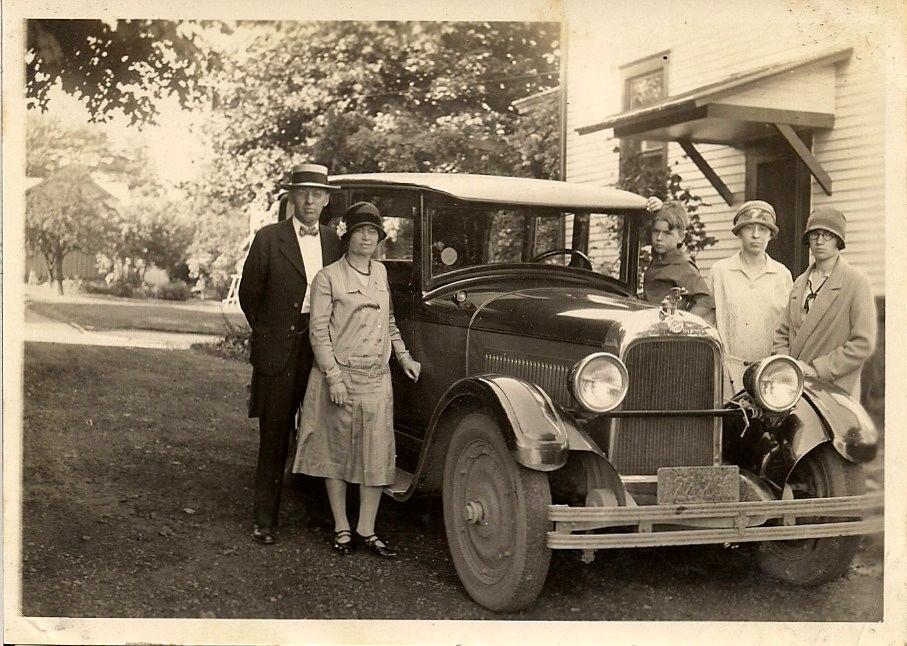
Charles, Emily, Bill, Mabel (Charles’ sister) and Esther Llewellyn in Barnesville, Ohio in 1930.
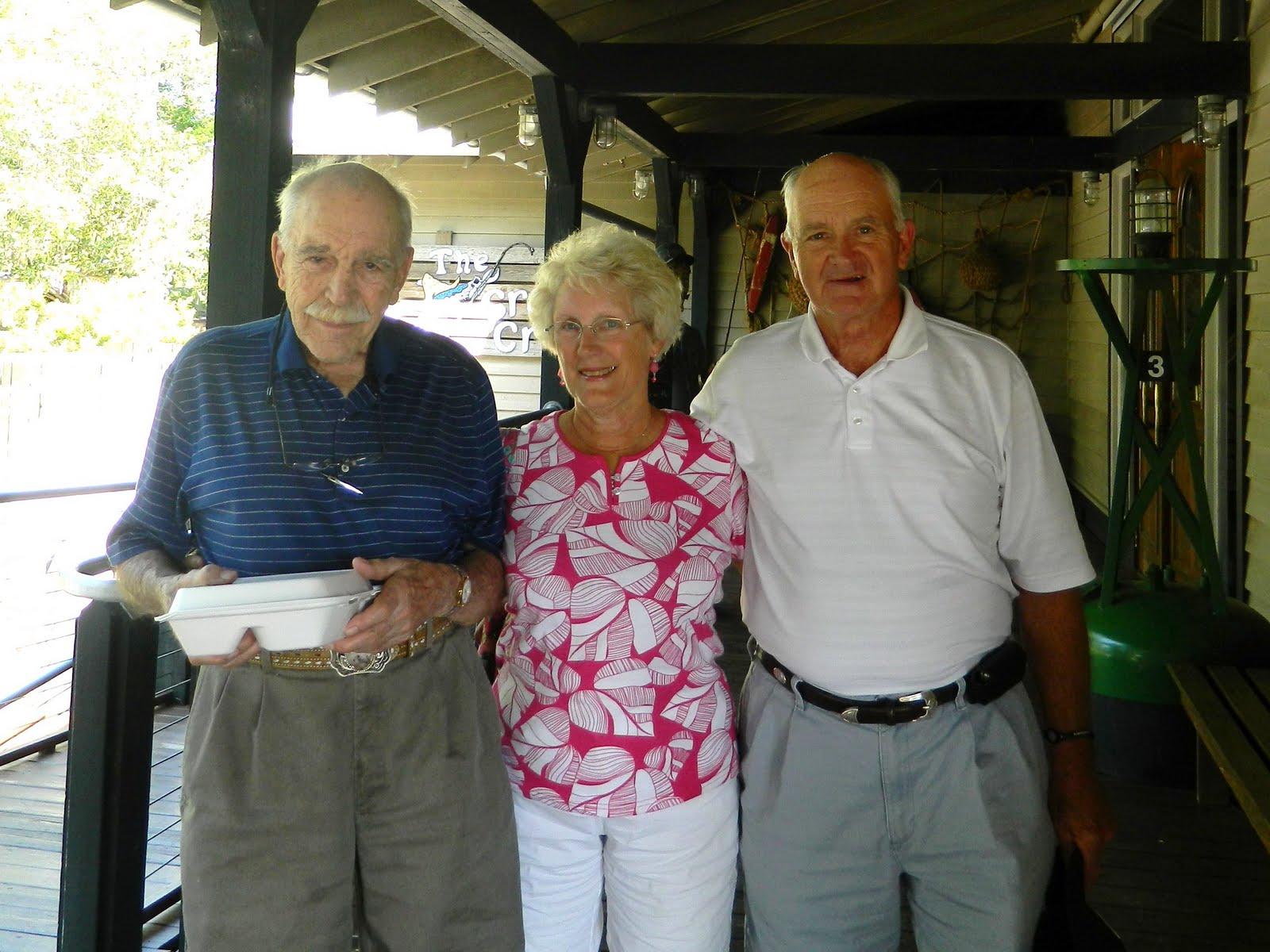
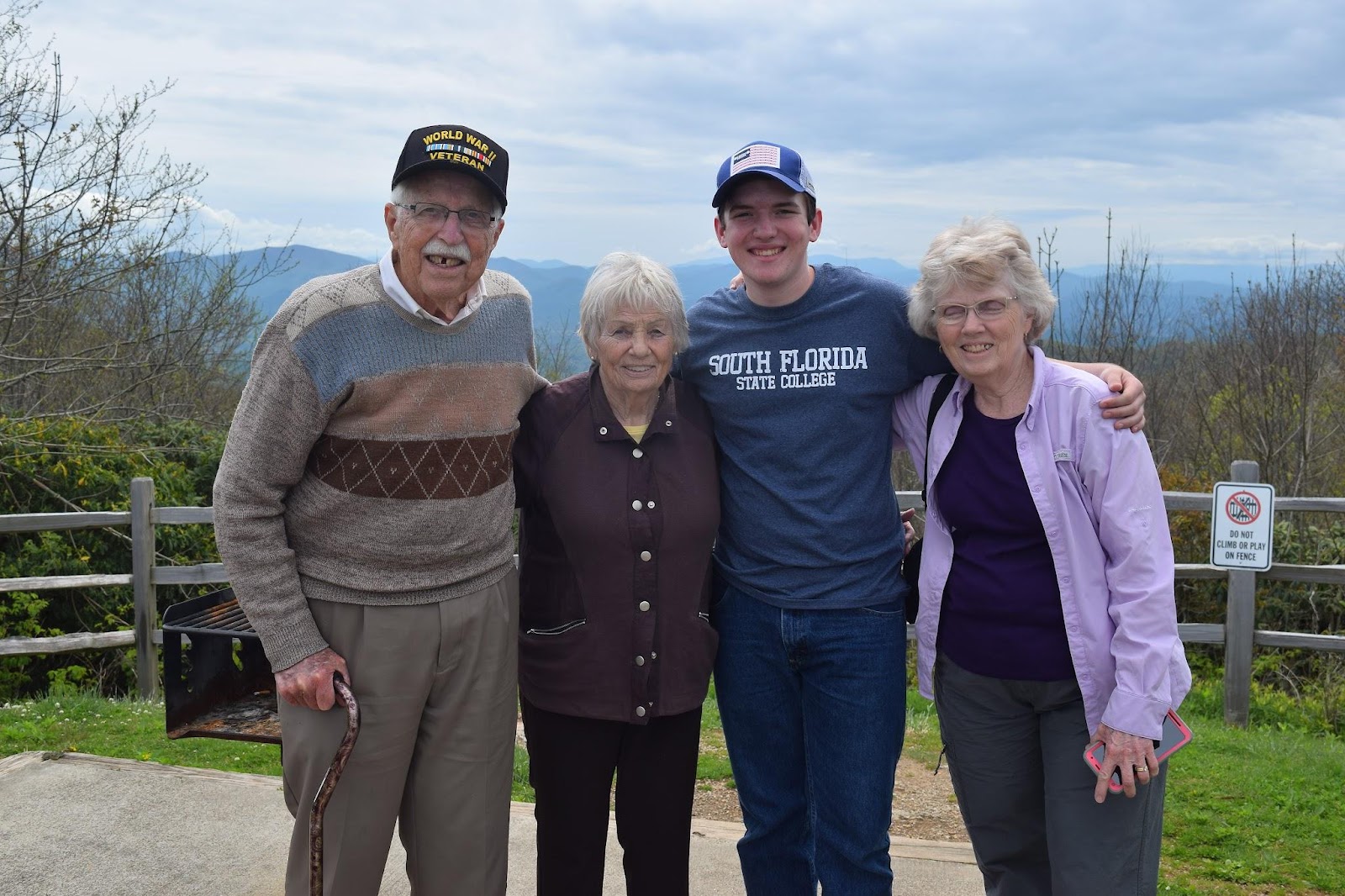
Bill Llewellyn with Judy Vail Reese 2012
SH: This is side two of tape two.
WL: Okay, so, John, when we got on the LCI, would kneel down by my bunk and say his prayers and that was kind of a little embarrassing, as I lay there smoking a cigarette. So, I moved in with Gebhart and this other young officer, we had four on the boat sometimes, he moved in with John, and they used to argue Catholic things. [laughter] There was … another officer I knew, … whose name I don’t remember any longer, but he was madly in love and he and his girlfriend got married just before they shipped out. He was on one of the other LCIs and I knew him pretty well and he said [that] they didn’t have sex, that they weren’t going to have [sex]. They wanted to be married so [that] they got the pay while he was overseas, but they weren’t going to have sex until they were married in the Church. So, as I say, it was kind of a nice world, but it was different. [laughter] …
SH: Were your parents able to travel out to Madison for the wedding?
WL: Yes, yes, they came out and they were there. Of course, I … didn’t know much [of] what was going on hardly. … [laughter] Then, an old roommate of mine and a fraternity brother, Barclay Malsbury, [who] died a few years ago, he was fairly active in the Rutgers alumni stuff, but he was in the Air Corps and I somehow got a hold of him and he and his wife flew up. … He’d been overseas, but they were in Louisiana, I think, in an airbase. They flew up and he was my best man. So, he helped me through. Other than that, it was [just family].
SH: Was there housing for you and Stella in Detroit?
WL: No, no, we had to find someplace.
SH: Was that tough?
WL: Yes. … Finally, we were in a hotel for a few days, but hotels only cost about three-and-a half bucks a night, though, you know, in those days. We used to stay in the Pennsylvania Hotel in New York City and that was, … as I recall, three-and-a-half bucks, [laughter] a nice world, and so, we found a little place. … I was saying, "Well, maybe you’ve got to go home." She says, "Nope, we’re going to live together." So, she found a place and it was … a little apartment
40
in the back of the house, right opposite that island in the Detroit River, [Belle Isle?] but, anyway, I got off … the trolley at Crane, Hibbard and Holcomb, I remember that, to go home, but it was an old couple [that] owned the house and they had this thing in the back. … Of course, they enjoyed having a young married couple there, but his name was Frame. [laughter] So, he felt like …
SH: Family.
WL: And he was a Fuller Brush man.
SH: Did any part of your Rutgers education help you when you were in the military? Did it come into play more in your civilian life?
WL: An education is an education, you know. [laughter] I was one of the few engineering officers, I think, that really was an engineer, … so, that helped. …
SH: Did you ever entertain any thoughts of staying in the military?
WL: No. …
SH: You mentioned that you got your orders to return to the States the day Roosevelt died. What was the reaction of the men around you? What did you think of Truman’s ability to govern?
WL: Oh, Truman horrified us. [laughter] As my father said, "The haberdasher from St. Louis." [laughter] … He embarrassed you when he was in public and [said] some of the things he said. It was only later that you realized he was a pretty solid guy. … No, we knew that Roosevelt was [sick]. We didn’t know how bad, but we knew he was pretty bad and, obviously, he shouldn’t have been there for several years, because he … practically gave the store away while he was dying, but, no, Truman was an embarrassment and only later did we realize he was kind of one of the best ones, maybe, yes.
SH: Do you recall any of the celebrations that followed the end of the war in Europe and the Japanese surrender? Did you take part in any celebrations?
WL: … Yes. When did it [end]?
SH: The war in Europe ended in May of 1945.
WL: That was when it ended in Europe? So, I was at sea or something, then, I think. SH: That is right. You did not go there until …
WL: July.
SH: You would have been coming back then.
41
WL: Yes. I have … very little recollection of the ending of the war in Europe, except that it happened. I was in Detroit when V-J Day [happened] and that, of course, was a happy time. …
SH: You were in Detroit when the war ended.
WL: Yes.
SH: Were you released immediately? What did they do with you?
WL: … I actually got out in November, some time, and then, the termination date was December, … because of accumulated something or other, [leave time?], but I think I attached a copy of the thing, [his discharge papers]. It doesn’t say where; I think I got out at Great Lakes or something like that, but I don’t really know what the location was. I don’t think it was in Detroit itself, but I’m not sure. It might have been. … I remember being interviewed by the guy and I just don’t remember where. … Then, we went back to Madison, … and then, I contacted, wrote a letter to, Westvaco in Charleston and, you know, … of all things, that letter got lost, because … I contacted them later and they had never received it. … As I waited, I wasn’t sure I wanted to bring a Wisconsin bride to Charleston, South Carolina, because [there was] no air-conditioning, [there were] cockroaches this long running around, and so, when I didn’t hear right away from Westvaco, I started looking at some of the paper mills in Wisconsin, Kimberly-Clark. … They said, "Sure, we’ll give you a job," and I said, "Where?" and they said, "Well, you’ll be out here … on a drawing board," and there’s about thirty drawing boards out there and I said, "No thanks, I don’t think I want to do that." So, I went to [the] Marathon Corporation. They had a converting [plant] and some mills in [the] Neenah/Menasha area and they said, "Well, we think (Grover Keith?), up in Wausau, Wisconsin," … their original mill was in Wausau, "is looking for somebody, if you want to go up there." So, I went up there and talked to Grover Keith and he said, "Yes," and so, I got a job there and, actually, … this was an old mill. … So, my first winter was in Wausau, Wisconsin, after two years in the South Pacific, and I don’t know … if you’ve ever seen [this, but] there’s an ad, Employer’s Mutual or something like that, that shows the Wausau train station, on TV. Well, I had a room and I walked past that thing every morning to the bus station. I didn’t have a car and it was ten, fifteen below every morning, [laughter] and then, I’d take this bus out to the mill, and then, Stella came up and we got a crazy little apartment. … The people [do not] realize today … what nice places they can rent. There was nothing, you know. This was a one-room deal on the third floor or something, … but, then, they had bought a mill over in Menominee, Michigan, on Green Bay, at the mouth of the Menominee River, and so, they transferred me over there in May, and then, I was there from May … ‘46 to ’51. … Then, in ’51, … we bought a mill out in Oswego, New York, and I went out there as plant engineer. I was out there for eight years, … but that first winter in Wausau, oh, it was cold. [laughter]
SH: You mainly stayed with the paper mills.
WL: I stayed in the paper industry, yes, … actually, the whole time.
SH: Were you mostly situated in the New York/Great Lakes area?
42
WL: No. I was in Oswego as plant engineer until ‘59, and then, I went back to Neenah, Wisconsin, where we had the central engineering [department] and worked on projects in Naheola, Alabama. … We had a paper mill expansion and new board machine down there, and then, another expansion there, and so, I spent a lot of time in Alabama, but I didn’t want to move my family down there. I had kids in high school. So, I would go down on a Monday and stay two weekends and come back on a Friday, and then, stay a week, and then, do another three weeks [there] and I worked it that way and the family lived in Appleton, Wisconsin, where there were good schools. … So, that was during the Martin Luther King times and everything. [Editor’s Note: Mr. Llewellyn is referring to the Civil Right Movement.] … I took the position, I told Southerners I knew that I didn’t agree with what they did, but I stayed out of it, other than that. It was their state, not mine. … When I came South in ’41, of course, it was totally segregated and the work crews out at the mill would always have a white foreman, even if everybody else was black. Blacks just didn’t have a chance on anything. … Again, I stayed out of it. When they asked me, I told them I disagreed with it, but I left it at that.
SH: From Appleton, Wisconsin, where did your family move?
WL: Oh, then, … that was ’59, we went … back to Appleton. … In ’57, American Can had bought Marathon Corporation. Marathon Corporation … made the first frozen food packaging for, what was the original frozen food people?
SH: Birdseye?
WL: Birdseye, yes, and they worked with Birdseye on their early packaging and they were bread wrapper and food packaging [products], you know, solid bleach food board products, and then, in around [the] early ‘50s, they bought Northern Paper Mills, and so, they got into Northern Tissue and Towel and most of the machines I put in were for toilet tissue or were tissue machines. So, I’ve made enough toilet paper to supply the world for a long time. … In ‘66, when American Can decided to reorganize and … centralized their engineering, … they had the can operations, of course, they had Dixie, they’d bought Dixie about the time they bought us, and then, they had our tissue and towel and food packaging, and they put all the engineering together in Fairlawn, New Jersey. … The guy who was chief engineer in Neenah just didn’t like the [idea], decided he didn’t want to go to Fairlawn, New Jersey, and get mixed up in this thing. So, he left and went with Champion Corporation and they made me chief engineer for the pulp and paper operations. So, I moved the remnants of what used to be an engineering department to Fairlawn and rebuilt it there, because a lot of the guys quit. … They’d always lived in Wisconsin and they weren’t about to move to North Jersey, and so, I was working in Fairlawn [in] ’66. … During that period, we built a new mill in Halsey, Oregon, which was for tissue and towel, and that was the first mill in the country that didn’t smell. … We decided we wanted to do it if we could, and then, the community, you know, Eugene, Oregon, it was just … thirty miles out of Eugene, they were all far-out liberals and everything there, and environmentalists. So, we actually collected all the stray smells and incinerated them in the lime kiln … So, the mill didn’t smell. It was a clean mill that way and that started up in ‘69, and then, the head of pulp and paper operations, a VP, a guy named John Bard, I never did like the bastard and he didn’t like me either. So, I had to get out of paper mill engineering in American Can and I was made director
43
of environmental engineering in the environmental group for the whole corporation. … We fooled around with such things as the "litter gulper," which was [to] pick up cans and litter along the highway, and some of the other problems. … I was working, then, in Greenwich, where they’d moved out of 100 Park Avenue, like everybody else in New York was doing at that time, to a big office in Greenwich, Connecticut. So, I commuted. … When we moved back, we were living in Upper Saddle River, and so, [I had] to go down to Fairlawn, and then, I commuted across the Tappan Zee, about forty miles each way, for three or four years, when I was working in Greenwich. … Then, Champion, my old boss, who had … left Neenah, went to Champion, they had an opening for directing an expansion and they had a mill in Mogi Guacu, Brazil. … You know, with Stella, she’d been born in Argentina, and so, I said, "Okay." I took a three-year contract then to go down to Brazil. We lived in Campinas and worked in Mogi Guacu. … It was my fault. I didn’t handle it, the language and everything else, and so, they were in the process of replacing me when, and I know that, I have the guilt, that that was a factor, but, anyway, Stella contracted polio down there and that was in December ’75, yes. … We’d been down there a little over a year, a year-and-a-half, and she [was] paralyzed right up to her neck. She couldn’t turn her head. All she had was her face and her mind. Otherwise, she was totally paralyzed and it shouldn’t have happened. She shouldn’t have … caught it at that age and, if she caught it, it should have killed her, and it didn’t quite do either, you know. … So, I had to bring her back to New York and she was on Roosevelt Island, in Goldwater Hospital, … as a quadriplegic, from about March of ‘76 until she died, in November of ’79. … So, I got jobs doing what I could around there and I worked for Parsons and Whittemore, in the Pan Am Building, … as assistant chief engineer for about a year-and-a-half, I guess, and then, they really moved all their operations to Alabama and I had to stay. … I was living on 220 East 54th Street, and then, when I finished work, … they put in the cable car over to Roosevelt Island, I’d go up … to ride the cable car over and visit with Stella for two or three hours every [day], you know. God, I couldn’t abandon her. If she were a vegetable, I could have walked away from it, but she was the same gal I married, except she couldn’t move, you know, and that’s a rough deal. … Then, I had a job with Rust Engineering. They opened up an international engineering office up in Greenwich and I tried commuting by train for about a week [laughter] and it was awful.
SH: It was what you said you did not want to do, correct?
WL: Yes, only other way, and then, you’re up there with no transportation. … I said, "I’m either going to quit this job or," I bought a car, bought a little … ‘76 Celica, I guess, and that was fun, you know. You’d leave about seven-thirty in the morning, driving out of the city, no traffic, and [come] back at night, not bad, … but you couldn’t park in front of the building where I was until seven o’clock. So, I’d just work a little late and I’d drive in and I’d get there about seven o’clock and park in front of the building and that worked out fine. … You couldn’t park there Saturday … or Sunday, and so, … some time Friday night, … I had to get the car someplace else. … I parked up by the heliport and all over the place, and then, I found out that the clubs that close about four o’clock in the morning [had parking]. … I’d set the alarm and get up at four o’clock in the morning and take the car from in front of 220 East 54th Street over to about, oh, 52nd and Third; between First and Second Avenue, they had alternate side parking. … These guys would be leaving and I’d park my Celica there for the weekend and that worked fine, as long as I was there, and I did that for a couple of years. [laughter] You tell people you get up at four o’clock in the morning to park your car, they’ll think your nuts.
44
SH: Stella and you had two sons.
WL: Yes, we had two sons.
SH: Can you tell me about them? Did they go to college? I was going to ask about the Vietnam War, since your sons’ generation was involved.
WL: … They were thirteen months apart, born in ‘46 and ‘47, and so, they weren’t in the war. Peter, the older [one], graduated from the University of Wisconsin, … and the year, now, I’ve forgotten, and then, he went into the Peace Corps. That’s the way he avoided Vietnam. … I think Peter was a little slow in getting out of college, so, John graduated about the same time, but his girlfriend, who wanted to marry him as soon as possible, her father was Annapolis, Class of ’42, I think, so, … he went into the nuclear sub program. … He graduated from Duke and went … directly into that, and then, after his indoctrination as a naval officer, they got married that June, I think. … He graduated in the middle of the year. He started out as a physics major and changed to mechanical engineering, after he found physics majors had to learn languages and things, which he wasn’t any much better at than I was. … That was always my disappointment; I never learned Portuguese well enough to think in it. … They say when you really know a foreign language, you can think in it, and I know a little, but, as I say, my (secretary bilingual?) … got much better at her English, but I didn’t learn much Portuguese. [laughter] … So, that’s the way they avoided Vietnam. … Peter, right now, he’s still living in Honduras and he’s kind of messed up his life. He tried to start a fish farm and I don’t think that’s working very well. … Why would you want a fish farm in the poorest country in the Western Hemisphere, you know? which is Honduras. His daughter, my granddaughter, stopped by this summer. She’s up living with an aunt in Union City, New Jersey, and his son is fifteen. He came up a month or so ago. He’s with Uncle … (Noël?) in, what’s the German name, oh, right near Union City? anyway, but the whole family is up here. Peter’s still in Honduras, you know. All the Hondurans want to be up here and he’s down there. … So, I don’t know how he’s going to come out.
SH: Did your other son retire from the Navy? Did he stay in?
WL: No, he didn’t stay in. His wife pulled him out after eight years, because, as she said, … they have two daughters, … her mother and her grandmother raised her and she didn’t want to raise their daughters with her mother while John was off at sea. So, he got a job with Union Camp, here in Savannah, when he got out of the Navy, back in, a long time ago. … About five or six years ago, I guess, Union Camp was sold to International Paper, I think. … He’s decided, along the way, that I wasn’t very nice to him, or to his wife, or I favored his brother or something, so, he doesn’t talk to me. … So, that’s kind of sad, it’s silly, but, if that’s the way he wants it; I talk to his wife once in a while. She has a business in Savannah here, Llewellyn and Associates. She’s an enrolled agent for taxes and she’s a good accountant. She is a pain in the ass in some other ways … and she convinced John that he’d been abused. … I don’t care. [laughter] So, I think she over convinced him and, all of a sudden, he decides that his mother and father favored his brother and he wasn’t treated fairly, and he kind of sulked, anyway, though. I realized, in looking back at pictures, he was always sulking about something. … I’ve lost him.
45
So, that’s all right. As I say, I keep track of his daughters and by talking to his wife once in a while and that’s the way it goes. [laughter]
SH: You remarried.
WL: … Stella died in November of ’79. … There was a guy, Bob (Gravis?), also living in 220 East 54th Street, who died of prostate cancer in April of ’79. … When you live alone in a … "doorman" apartment house in New York, why, you have a favorite doorman you tell your troubles to, and Jack (Hogan?), when he was sober, was a great doorman, [laughter] good Irishman, and, one day, he brought Connie Gravis, a few months after Stella died, over to me and he said, "You two ought to know each other," [laughter] and we did. She’s been a wonderful wife and we’ve had a lot of fun and she’s totally different from Stella and that’s the way I wanted it. [laughter] …
SH: How long have you lived on Hilton Head?
WL: Too long. We didn’t expect it to be this long, but I did several things towards the end there, after Stella died. … The last job, I was working … at Simons-Eastern, which was a US affiliate of HA Simons, which I worked for for eight or ten months, out in Vancouver, British Columbia. … Connie and I lived out there for a while, and then, we moved and I was working in Atlanta and we were living together there, and then, we invited the nice couple we knew below us if they’d like to come to our wedding and [they said], "Ah, you’re not married?" [laughter] We said, "No. Second time around, it [living together] doesn’t seem that important," you know. [laughter] So, then, when that job … ended; it was an expansion job at a paper mill in Augusta, Georgia, … that I was involved with in the consulting engineers office, HA Simons, and that ended in December. So, I was terminated in December of ‘82. So, we came down here in ‘83 and, you know, after a while, … I was sixty-three or four and, if you had a regular job and you were into [your mid-sixties], you’d stretch it out as long as you could. I don’t think they should let you, but you could, but, … after you sell yourself in another job, you say, "Oh, the hell [with this], I don’t feel like selling myself anymore," and I had enough that I thought I [should retire]. I haven’t handled … some of it too well. I lost a little money a couple of times, but there’s still enough. So, we’ve stayed here since ‘83.
SH: Do you have a passion now, anything that you are active in?
WL: It’s been golf, basically, and my springer spaniel. I’ve got a passion for a springer. … In the last few months, she’s eleven years old and she got all crippled up with arthritis and we can’t take our walks every night. I take her out for a walk and she sits on the pad and I get out there and I say, "Come on, Molly," and she sits there and just looks at me, doesn’t move. So, I say, "Okay," and I go back and we do something else, but its [primarily] golf, and I’ve enjoyed doing things around the house, in the yard. …
SH: How do you think World War II shaped the man you are today?
WL: I don’t know. …
46
[TAPE PAUSED]
I mean, I was in Charleston, I was working at Westvaco, I was beginning to go with a Betty Techlenberg, a very nice young lady that worked for the personnel manager at the mill, … the personnel manager later became the manager, and I probably would have married and stayed in the Charleston area. … I didn’t tell you how I met Stella, did I? Oh, yes, (Freeman Hyman?) and so on, yes, and that was the first time I’d really fallen madly in love. So, I sent Betty the letter that said, … "Something happened and I won’t be seeing you like I thought I might," and so, that got me to Wisconsin. It certainly changed where I lived. I had been in the paper industry enough before the war that I liked it and it was a nice industry. It’s not quite as nice [now]. Nothing’s quite as nice anymore. Of course, they say people in their eighties don’t like anything and I’m no exception. I think the world’s going to hell. … I went in as an engineering officer and it was a wonderful adventure, but, other than that, I don’t think it changed me too much. … There weren’t any … life changing revelations or anything that came about. … Then, I wasn’t involved in the type of action … where I’d maybe live, maybe die. …
SH: Did you use any of your GI Bill benefits?
WL: Oh, just once, in living in Oswego, and I think I mentioned that, I think it’s ’53, I bought a National home, which was a prefab house, one of the first ones. … I got a GI loan for thirteen thousand dollars to help buy the thing, but that’s the only [time]. I wasn’t any place where I could use education benefits or anything. All these guys that lived in the city [could] and I was always; you know, paper mill towns are great. I loved them, a nice place to [live]. …
[TAPE PAUSED]
Where was I?
SH: You were talking about the mill towns.
WL: … I mean, they were great places to raise families and I ate lunch at home, really, until the kids were … out of high school. … There was no place else to eat. I just came home. It was the easiest thing to do. So, it was a nice life, but there weren’t any schools or things. When I got to
New Jersey, I’d hire some of these guys to work in the engineering department and they’d have about five degrees, but, you know, it was [due to] boredom and that was their recreation, you know. It didn’t mean they were any better at what they did. [laughter] … That’s about it.
SH: Unless there is anything else that you want to add to the tape, I thank you again for coming. WL: I guess we covered most of it.
SH: I look forward to seeing your letters and documents.
WL: Yes. … You might as well have these things someday, so, I’ll kind of aim in that direction. You want some pictures [to go] along with them?
47
SH: Of course. Thank you again.
WL: [laughter] Okay. …
---------------------------------------------END OF INTERVIEW-------------------------------------------
Reviewed by Brett Gorman 2/12/06
Reviewed by Shaun Illingworth 3/2/06
Reviewed by William Llewellyn 11/20/12
48